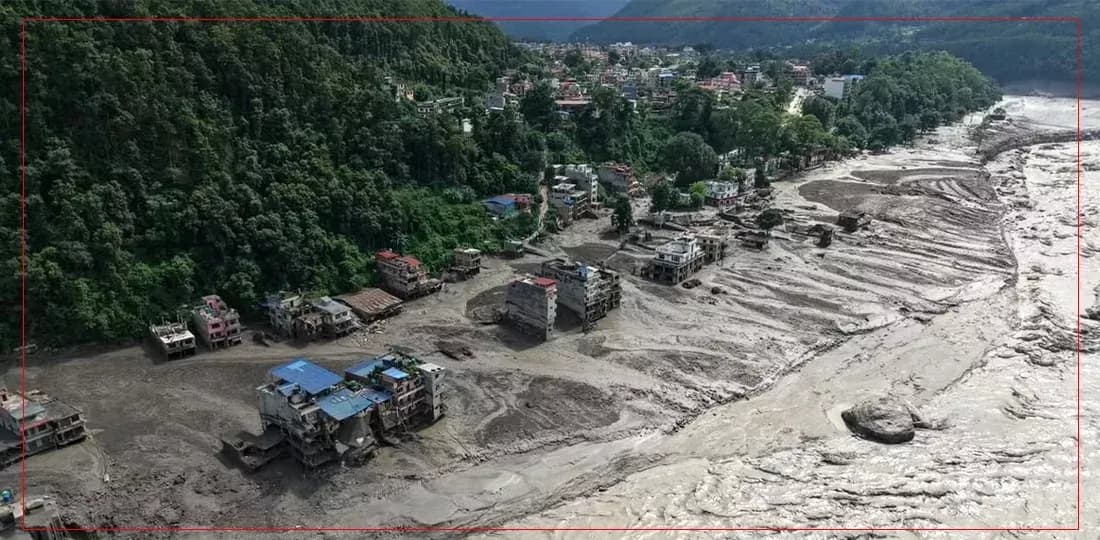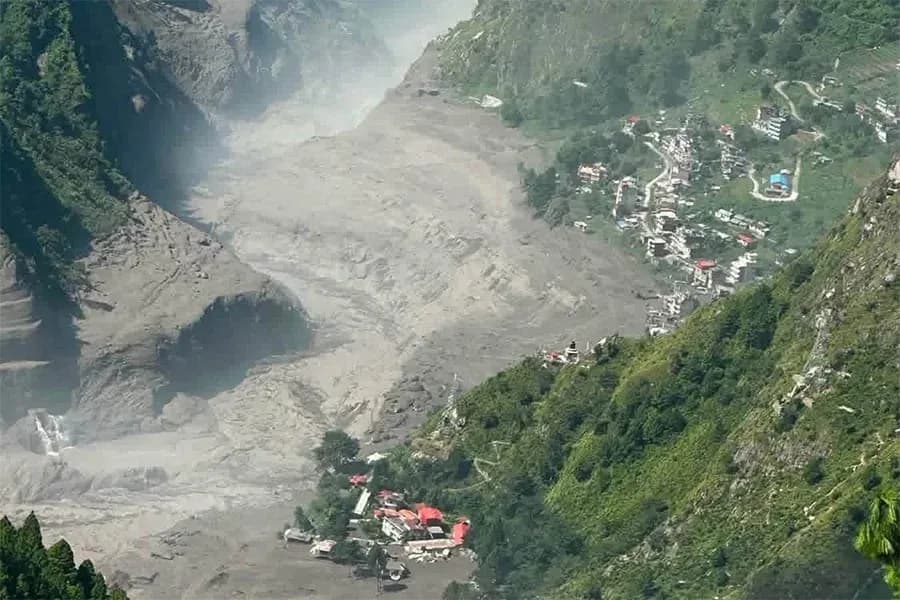
A sudden and destructive flash flood swept through Nepal’s Rasuwa district on Wednesday, August 26, 2026, after a large volume of water, mud and rock entered the Bhote Koshi River from the Tibetan side. The flood struck the Timure, Rasuwagadhi and Syafrubesi areas before moving downstream through the Bhote Koshi and Trishuli river corridors.
The disaster damaged settlements, roads, bridges, border facilities, hydropower projects, electricity infrastructure and businesses. Nepal Police reported that 95 bodies had been recovered and 63 injured people were receiving treatment in the latest update available on August 26. The Nepali Army said 88 people had been rescued, while hundreds of residents, workers and travellers remained out of contact.
The exact cause is still under investigation. The strongest working explanation is that an ice-and-rock avalanche or landslide upstream in Tibet temporarily blocked a river and then released a sudden debris-laden surge. Experts and authorities were also examining the possibility of a glacial lake outburst and whether an earthquake contributed to the slope or glacier failure.
Rasuwa Flood 2026: Quick Facts
Date: Wednesday, August 26, 2026
Main river: Bhote Koshi River
Main affected areas: Timure, Rasuwagadhi, Syafrubesi, Dhunche, Mailung and downstream settlements
Latest bodies recovered in Nepal: 95
Injured people receiving treatment: 63
People rescued in a major Army update: 88
Travellers reported out of contact: Figures differed between 384, 403 and 484 in separate updates
Likely cause: Possible ice-rock avalanche or landslide with temporary river blockage and sudden release
Travel status: Non-essential travel to affected river corridors should be postponed.
Important: Figures are changing as rescue, identification and communication-restoration operations continue. A person reported missing or out of contact should not automatically be counted as dead.
What Happened in Rasuwa?
A sudden wall of water, mud and debris entered Nepal from the Tibetan side at approximately 8:30–9:15 AM on August 26. The surge entered the Bhote Koshi River and moved rapidly through the northern Rasuwa corridor.
The first major reports came from the Timure and Rasuwagadhi areas near the Nepal–China border. The flood then affected Syafrubesi, Mailung and other settlements before moving downstream toward the Trishuli River system. Authorities issued warnings for riverbank communities in Nuwakot, Dhading, Gorkha, Chitwan and other downstream areas.
The event was unusually sudden. It carried large amounts of mud, boulders and debris, damaging or sweeping away homes, vehicles, bridges and public infrastructure. Damaged communication links made it difficult for authorities to immediately verify the whereabouts of residents, workers and travellers.
The disaster also struck a strategically important corridor. Rasuwagadhi is one of Nepal’s main land-trade links with China, while the surrounding river valley contains hydropower plants, customs facilities, hotels, markets and roads connecting the border with central Nepal.
Where Did the Bhotekoshi Flood Hit?
The main impact zone was the upper Bhote Koshi corridor in Rasuwa, especially the areas around Timure, Rasuwagadhi and Syafrubesi. The flood also affected settlements and infrastructure toward Dhunche, Mailung and downstream river areas.
| Area | Reported impact |
|---|---|
| Timure | Floodwater and debris damaged settlements, businesses, border-area structures and public facilities. |
| Rasuwagadhi | Customs facilities, roads, bridges, trade infrastructure and nearby businesses were affected. |
| Syafrubesi / Syabrubesi | Settlements and transport links were affected, with helicopter rescue operations conducted. |
| Mailung and Dhunche | People required rescue and evacuation, while road and communications access was disrupted. |
| Nuwakot and Dhading | Downstream flooding, deaths and infrastructure damage were reported along the Trishuli corridor. |
What Caused the Rasuwa Flash Flood?
The exact cause has not yet been confirmed by a final scientific investigation. Therefore, it would be inaccurate to state that the flood was definitely caused by a glacier collapse, earthquake, cloudburst or climate change.
Leading working explanation
The strongest current explanation is that an ice-and-rock avalanche or landslide occurred upstream in Tibet. The debris may have temporarily blocked the Lhende River, creating a natural dam or debris lake. That blockage may then have failed suddenly, releasing water, mud and rock into the Bhote Koshi system.
Satellite analysis cited by Nepal’s disaster authorities indicated a possible ice-rock landslide approximately 20 kilometres northeast of the Rasuwagadhi border crossing. Reuters reported that early expert analysis pointed to a glacier-related collapse that generated a debris-laden flood.
Could it have been a glacial lake outburst?
A Glacial Lake Outburst Flood (GLOF) occurs when water stored behind ice, moraine or landslide debris is suddenly released. Some experts suggested that an upstream blockage or debris lake may have burst during this event.
However, GLOF remains a possible mechanism rather than a confirmed final cause. Authorities still need to establish whether a pre-existing glacial lake was involved, or whether the flood resulted mainly from an avalanche-triggered river blockage.
Could an earthquake have triggered it?
Reuters reported that a magnitude-4.4 earthquake occurred approximately seven minutes before the time shown on security-camera footage associated with the flood. It is possible that seismic shaking contributed to a slope or glacier failure, but the timing alone does not prove causation.
Was heavy rain the cause?
Department of Hydrology and Meteorology-linked reporting said the flood was not explained by heavy rainfall in Rasuwa. The preceding rainfall was described as light. This makes local cloudburst a less likely immediate explanation, although the complete upstream hydrological sequence still requires investigation.
Latest Deaths, Missing People and Rescue Updates
Casualty figures changed rapidly during August 26. Early reports mentioned seven or eight deaths, followed by updates of 22, 72 and 95 as bodies were recovered in Rasuwa, Nuwakot, Dhading, Gorkha, Chitwan, Tanahun and Nawalparasi East.
The latest accessible Nepal Police update reported by Onlinekhabar said 95 bodies had been recovered in Nepal. It also reported that 63 injured people were receiving treatment at hospitals.
| Status | Latest available figure | Source / timing |
|---|---|---|
| Bodies recovered in Nepal | 95 | Nepal Police update reported by Onlinekhabar, August 26. |
| Injured receiving treatment | 63 | Hospital and Police update reported by Onlinekhabar. |
| People rescued | 88 in the major Army update | Nepali Army update reported by Kathmandu Post. |
| Travellers out of contact | 384, 403 or 484 in different updates | Tourism Board and government-linked lists were still being reconciled. |
| Foreign travellers in reported lists | 291–391 depending on the update | Preliminary Tourism Board and government figures. |
| Nepali travellers in reported lists | 62 or 93 depending on the update | Preliminary agency and government lists. |
| Police personnel out of contact | 28 | Nepal Police breakdown reported by Onlinekhabar. |
| Rasuwa Customs employees out of contact | 15 | Customs official cited by Kathmandu Post. |
| Langtang Khola hydropower workers out of contact | 60 | Project promoter’s preliminary figure. |
Why are there different numbers? Some figures counted only confirmed bodies, while other figures included people reported out of contact by travel agencies, project operators, security units or families. Downstream bodies were also recovered in several districts as rescue and search work continued.
Figures are changing as rescue and identification operations continue. Traveller numbers indicate people who could not initially be contacted, not confirmed deaths.
Damage Caused by the Rasuwa Flood
The flood caused severe damage across the Bhotekoshi corridor. Final figures for destroyed houses, businesses and infrastructure were not yet available because many areas remained difficult to reach.
| Location / sector | Reported damage | Current status |
|---|---|---|
| Timure | Homes, hotels, businesses, border structures and public facilities affected by floodwater and debris. | Search, rescue and damage assessment continuing. |
| Rasuwagadhi | Customs facilities, roads, bridges, trade infrastructure and nearby businesses damaged. | Border trade route disrupted. |
| Syafrubesi | Settlements and transport links affected; people evacuated by helicopter. | Emergency response continuing. |
| Bhotekoshi corridor | Riverbank settlements, vehicles, roads and bridges swept away or buried in mud. | Riverbank areas remain dangerous. |
| Betrawati–Rasuwagadhi road | Major road sections and several bridges damaged or washed away. | Border access cut or severely restricted. |
| Hydropower projects | Power plants, headworks, project sites, transmission structures and substations affected. | Technical assessment required. |
Impact on Rasuwagadhi Border and Trade
The flood struck Rasuwagadhi, one of Nepal’s key land-trade links with China. Customs facilities and nearby roads were damaged, while several customs employees were reported out of contact.
The approximately 42-kilometre Betrawati–Rasuwagadhi route was damaged at multiple points, with bridges swept away. This disrupted cargo movement, customs work, local businesses and access to the Nepal–China border.
The border crossing should not be treated as normally open until official agencies confirm that the road, bridges, customs facilities and surrounding slopes are safe. Traders and travellers should rely on notices from the District Administration Office, Department of Roads, customs authorities and border officials rather than old travel schedules.
Tourists and Kailash Mansarovar Pilgrims
The Rasuwa border corridor is used by domestic and foreign tourists, including travellers heading toward the Nepal–China border and the Kailash Mansarovar pilgrimage route.
The Nepal Tourism Board initially reported 384 travellers out of contact, including 291 foreign nationals and 93 Nepali nationals. Later reports mentioned 403 and 484 people, depending on the stage of list compilation. Reuters later reported a government-linked figure of 484 tourists, including 391 foreign nationals and 93 Nepalis.
Foreign nationals listed in reports included more than 100 Indians, three US citizens and 12 British nationals. Consular authorities, travel agencies and Nepali authorities were working to confirm the status of people on the lists. Being listed as out of contact did not prove that a traveller had died.
The Nepal Tourism Board advised tourists to avoid the affected Bhote Koshi and Trishuli corridors, postpone non-essential travel and follow official instructions.
Rescue and Relief Operations
The rescue response involved the Nepali Army, Nepal Police, Armed Police Force, local administrations, medical teams and private helicopter operators.
The Nepali Army reported that 88 people had been rescued in a major update. Earlier updates had reported 12, 25 and other smaller totals as individual helicopter missions were completed. These numbers represent different stages of the operation rather than necessarily contradictory reports.
At least 12 helicopters, including military and private aircraft, were involved in rescue operations. Poor weather repeatedly disrupted flights, and several helicopters carrying supplies were forced to turn back.
According to Nepal Police figures reported by Onlinekhabar, 63 injured people were receiving treatment at hospitals including Tribhuvan University Teaching Hospital, the National Trauma Centre, Birendra Hospital, Rasuwa Hospital, Trishuli Hospital and private hospitals.
Rescue priorities
- Locate people trapped or stranded in Timure, Syafrubesi and downstream settlements.
- Verify the status of security personnel, customs employees, hydropower workers and travellers.
- Transport injured people to hospitals.
- Provide food, shelter, medicine and communication access to displaced residents.
- Search riverbanks, debris fields and downstream areas.
- Assess damaged roads, bridges, power systems and communications infrastructure.
For more Nepal news, disaster explainers and public-interest updates, visit the Tikajoshi Blog.
Roads and Travel Situation
Travel to the flood-affected Rasuwa corridor was not considered normal or safe while rescue and damage assessment were underway. Traffic authorities stopped or restricted vehicles travelling from Kathmandu toward Rasuwa, Nuwakot, Dhading and Chitwan as a precaution.
- Galchhi–Nuwakot–Rasuwa–Syafrubesi route: Flood and landslide damage disrupted access.
- Betrawati–Rasuwagadhi road: Major sections and bridges were damaged.
- Prithvi Highway: Travellers were advised to remain cautious because of downstream flood and landslide risks.
- Muglin–Narayangadh corridor: River and landslide conditions created additional travel risk.
- Trishuli River corridor: Residents and travellers were warned to stay away from riverbanks and damaged bridges.
Do not cross flooded roads, streams or temporary bridges. A road that appears passable can still be undermined below the surface or exposed to another landslide or flood surge.
For current affairs, sports and other trending updates, explore the Chill Zone.
Electricity and Telecommunications
The flood damaged several hydropower projects and electricity structures in Rasuwa and nearby districts. Reported affected facilities included Rasuwagadhi, Chilime, Trishuli-3A, the Trishuli-3B 220-kV substation hub, Trishuli and Devighat facilities.
Early reports cited damage to approximately 430 megawatts of generation capacity, including hydropower and solar facilities. Other estimates referred to around 354 MW of operational capacity and additional projects under construction. These are preliminary estimates and should not be treated as final engineering figures.
The damage caused power outages and contributed to communication problems. Mobile networks, electricity supply and local internet access may remain unstable until emergency repairs are completed.
Residents should preserve phone batteries, use official communication points when available and avoid repeatedly calling overloaded networks unless necessary.
If you need to reduce the file size of a flood photo, map or infographic before publishing, use the image compressor tool.
Government Response
Prime Minister Balendra Shah directed the mobilisation of the Nepali Army, Nepal Police, Armed Police Force, helicopters, medical teams and other emergency resources. The National Disaster Risk Reduction and Management Authority was involved in coordination and damage information collection.
The government ordered free treatment for injured people, emergency aid and financial support for families of those killed. It also directed agencies to work on restoring roads, electricity and telecommunications.
Authorities issued alerts for people living near the Bhote Koshi and Trishuli rivers in Rasuwa, Nuwakot, Dhading, Gorkha and Chitwan. People were asked to move to safer locations and avoid riverbanks, bridges and low-lying areas.
Why Is Rasuwa Vulnerable to Flash Floods?
Rasuwa lies in a steep Himalayan environment where glaciers, unstable slopes, narrow river valleys, hydropower infrastructure and settlements are located close together.
- Steep terrain: Water accelerates rapidly through mountain valleys.
- Glacier and ice-rock hazards: Ice avalanches, landslides and glacial lakes can release large amounts of water and debris.
- Narrow river channels: Temporary blockages can create sudden destructive surges.
- Monsoon instability: Rainfall can trigger landslides and saturate mountain slopes.
- Infrastructure concentration: Roads, hydropower projects, border facilities and settlements share the same river corridors.
- Limited warning time: A hazard originating across the border can reach Nepal before detailed warnings are issued.
- Difficult access: Damaged mountain roads and bridges slow rescue and relief operations.
The region also experienced a major flood in 2025. Later analysis linked that disaster to the sudden drainage of a supraglacial lake in the Purepu glacier area, which damaged border and hydropower infrastructure. That history shows the area’s exposure, but it does not prove that the 2026 event had exactly the same cause.
Could Glacier Collapse or Climate Change Be Linked?
Glacier-related hazards are plausible in this region, but climate change has not been confirmed as the direct cause of the August 26 flood.
The immediate event may have involved an ice-rock avalanche, landslide, temporary river blockage and sudden release. Climate change is a longer-term factor that can affect glacier retreat, melt patterns, glacial-lake formation and slope stability.
However, proving that climate change caused one specific flood requires event-specific research. The responsible conclusion is that long-term warming may increase exposure to some Himalayan hazards, while the direct trigger of this flood remains under investigation.
What People in Rasuwa and Nearby Areas Should Do Now
- Move away from the Bhote Koshi, Trishuli and other riverbanks if authorities issue an evacuation instruction.
- Stay on higher and stable ground, away from bridges, low-lying areas, steep slopes and debris channels.
- Do not return to damaged houses or businesses until local authorities confirm safety.
- Do not cross flooded roads, streams, damaged bridges or temporary crossings.
- Avoid unnecessary travel toward Timure, Rasuwagadhi and Syafrubesi.
- Follow instructions from local administrations, NDRRMA, Nepal Police, APF, Nepali Army and Tourist Police.
- Keep phones charged and report missing family members to designated police or administration points.
- Do not share unverified casualty lists, old videos or unconfirmed claims about the flood’s cause.
- Tourists should contact their embassy, travel agency, Nepal Tourism Board or Tourist Police if someone remains out of contact.
What We Know and What Remains Unclear
| Confirmed or strongly reported | Still being investigated |
|---|---|
| A sudden flood entered the Bhote Koshi system from the Tibetan side on August 26. | The exact upstream release point and full physical sequence. |
| Timure, Rasuwagadhi, Syafrubesi and downstream areas were affected. | Final number of destroyed houses, businesses and settlements. |
| At least 95 bodies had been recovered in Nepal in the latest Police update available. | Final death toll and identification of all victims. |
| Security forces and helicopters rescued dozens of people. | A single final rescue total covering all military, police, private and ground operations. |
| Roads, bridges, border facilities and hydropower infrastructure were damaged. | Final repair costs, generation-capacity loss and reopening dates. |
| Heavy local rainfall was not considered the leading immediate explanation by DHM-linked reports. | Whether the final trigger was an avalanche, landslide, GLOF, earthquake-assisted failure or a combination. |
| Hundreds of travellers were initially listed as out of contact. | The reconciled traveller figure and the number subsequently located safely. |
Frequently Asked Questions
What happened in Rasuwa?
A sudden flood carrying water, mud and rock entered Nepal from the Tibetan side and swept through the Bhote Koshi River corridor. Timure, Rasuwagadhi and Syafrubesi were among the affected areas.
When did the Rasuwa flood happen?
The Rasuwa flash flood happened on Wednesday, August 26, 2026. Major flood reports came between approximately 8:30 and 9:15 AM Nepal time.
What caused the Rasuwa flash flood?
The leading working explanation is an upstream ice-rock avalanche or landslide that temporarily blocked a river and then released water and debris. A possible GLOF and earthquake contribution were also being investigated.
How many people died in the Rasuwa flood?
The latest Nepal Police figure available in the research was 95 bodies recovered in Nepal. The number may change as search, recovery and identification work continues.
How many people are missing?
There was no single fully reconciled missing-person figure when this article was prepared. Separate updates listed 384, 403 or 484 travellers out of contact, while security personnel, customs workers, hydropower workers and local residents were counted separately.
Which areas of Rasuwa were affected?
Timure, Rasuwagadhi, Syafrubesi, Dhunche, Mailung and nearby settlements were affected. Downstream flooding and damage were also reported in Nuwakot, Dhading and other parts of the Trishuli corridor.
Is Rasuwagadhi border open?
Normal border trade and access were disrupted after roads, bridges and customs-area infrastructure were damaged. Travellers and traders should wait for an official reopening notice.
Is it safe to travel to Rasuwa now?
Non-essential travel to flood-affected areas should be postponed. Authorities and the Nepal Tourism Board advised people to avoid the Bhote Koshi and Trishuli corridors and follow official instructions.
What is the Bhotekoshi River?
The Bhote Koshi is a transboundary Himalayan river system that flows from the Tibet region into Nepal and continues through steep valleys toward the Trishuli system. Its corridor is important for communities, hydropower, tourism and Nepal–China trade.
Was the flood caused by climate change?
Climate change may increase long-term glacier and mountain-hazard risks, but it has not been confirmed as the direct cause of this specific flood. The immediate trigger remains under investigation.
Conclusion
The Rasuwa flood was a sudden transboundary disaster that affected communities, travellers, border trade and critical infrastructure along the Bhote Koshi–Trishuli corridor. The leading explanation involves an upstream ice-rock or landslide-related blockage and sudden release, but the final cause has not yet been established.
Rescue, recovery, victim identification, road inspection and infrastructure assessment are ongoing. Readers should rely on NDRRMA, Nepal Police, the Nepali Army, district administrations, the Department of Hydrology and Meteorology, the Nepal Tourism Board and other official authorities for emergency information.
Last updated: August 27, 2026, 12:24 AM Nepal time. Casualty, missing-person, road, border and rescue figures may change as authorities continue verification.
For more Nepal news, public-interest explainers and disaster updates, visit the Tikajoshi Blog.
For sports, entertainment and other trending stories, explore the Chill Zone.
For Nepal Stock Exchange information and live market updates, visit the NEPSE Live Market.
To compress the article cover image, flood map or infographic before uploading, use the image compressor tool.